
momaspet
Online Pet Consultancy & Veterinary Guidance
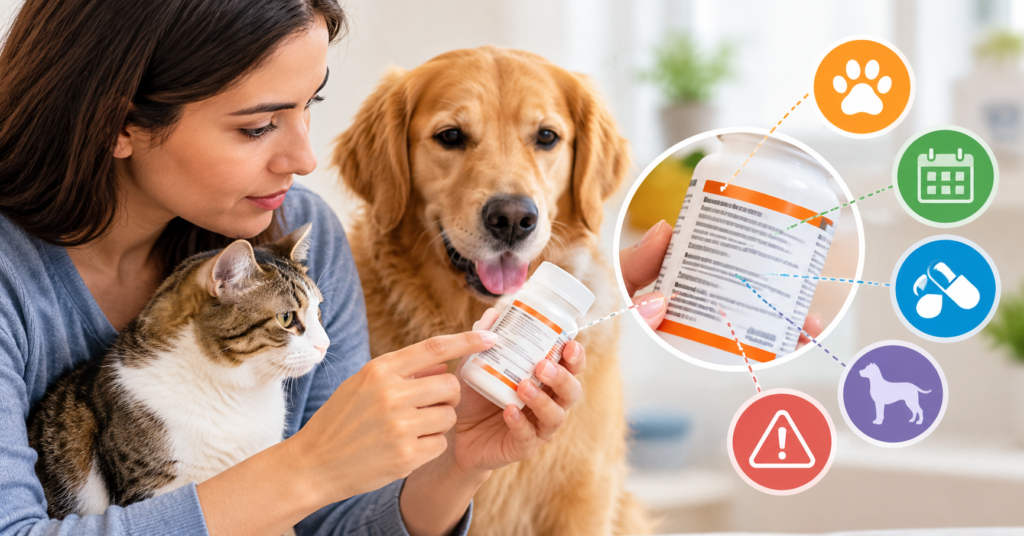
How to Read a Veterinary Medicine Label Before Giving Anything to Your Pet
Before giving a veterinary medicine, verify the exact product name, active ingredient, strength, intended species, directions from your veterinarian, warnings, storage requirements and expiration information. Keep the medicine in its original labeled container and never share one pet’s prescription with another unless your veterinarian directs you to.
Pet owners often search for a fast answer when something changes, but the safest answer is rarely a one-size-fits-all product recommendation. This guide explains how to read veterinary medicine label in plain language, shows what information is useful to track, and helps U.S. pet owners know when professional veterinary care matters.
1. Exact product and active ingredient
Brand names can be similar. Confirm both the product name and active ingredient so you do not accidentally duplicate therapy or confuse two formulations.
2. Strength and dosage form
A 25 mg tablet is not interchangeable with a 75 mg tablet, and a tablet is not the same as a liquid concentration. Strength is one of the most important details to verify.
3. Species and size information
Products may be formulated only for dogs, only for cats, or for a specific weight range. A medicine safe for one species may not be safe for another.
4. Prescription directions
The pharmacy or veterinary directions tell you how your veterinarian intends the medicine to be used. Do not substitute a blog, review or old instruction from another pet.
5. Warnings and precautions
Look for species restrictions, age limitations, pregnancy/lactation warnings, interaction cautions and instructions about what to do if adverse effects occur.
6. Storage
FDA advises owners to follow labeled temperature and light requirements and keep medicines secured from pets and children. Some products require refrigeration; others should remain at room temperature.
7. Expiration and container
Keep medicines in the original labeled container. An expiration date does not guarantee proper quality if the medicine has been stored incorrectly or contaminated.
8. Questions to ask before the first dose
Ask what the medicine is for, what to do if a dose is missed, whether it should be given with food, what side effects require a call, and what monitoring is needed.
How this connects to MomasPets
MomasPets can help you review product details, pack information and pet-care options after you have identified what your pet actually needs. For prescription or condition-specific medication, follow your veterinarian’s recommendation and any applicable U.S. prescription requirements.
Looking for clearly labeled pet-care products and practical product information? Browse MomasPets and verify the exact product, strength, species and pack details before checkout. For veterinary medicines, use your veterinarian’s guidance as the deciding factor. |
Frequently Asked Questions
What does mg/mL mean?
It states how many milligrams of active ingredient are present in each milliliter of liquid. Because liquid concentrations can differ, use only the exact measuring instructions provided.
Can I move pet pills into a pill organizer?
FDA generally recommends keeping animal drugs in their original labeled containers to reduce mix-ups and preserve key information.
Can I give one pet another pet’s prescription?
Not unless your veterinarian directs you to. Dose, diagnosis, species and health conditions may differ.
What if the label is damaged or unreadable?
Contact the dispensing veterinarian or pharmacy before using the medicine. Do not guess at the product or directions.

About Us.
As pet parents ourselves, we’re devoted to the well-being of all pets in all situations. Our entire existence is dedicated to a “pet-first” mentality that seeks the most optimal outcomes in every situation.
Newsletter.


momaspet is proudly powered by WordPress